
One of the most common framing deficiencies identified during inspection is not caused by poor workmanship, but by partial compliance.
Structural framing often looks solid on site, even when key alignment or bearing requirements are not fully met. Beams that are not fully supported, posts that are slightly off-center, or connections that rely on friction instead of direct bearing are regularly flagged during framing and final inspection.
This article explains why precision matters in structural framing, what inspectors look for, and why “almost right” framing conditions are typically not accepted.
Why Precision Matters in Structural Framing
Structural elements are designed to transfer loads in a clear and predictable path, from beams to posts, and down to the foundation.
When framing members are not properly aligned:
Loads are applied off-center instead of directly downward.
Supporting members are subjected to bending rather than pure compression.
Stresses are concentrated in unintended areas.
Even small misalignments can change how loads are distributed through the structure. While framing may appear stable during construction, these conditions can affect long-term performance once the building is fully loaded.
Common “Close Enough” Framing Conditions
Typical framing issues that are identified during inspection include:
Beams not fully bearing on posts or supporting walls.
LVL beams that extend beyond the width of the post below.
Posts not centered on footings, brackets, or beams.
Missing lateral restraint at beam ends.
Reliance on shims, nails, or friction rather than direct bearing.
These conditions often look acceptable at a glance, but inspection is not based on appearance alone.
Partial Bearing of LVL Beams
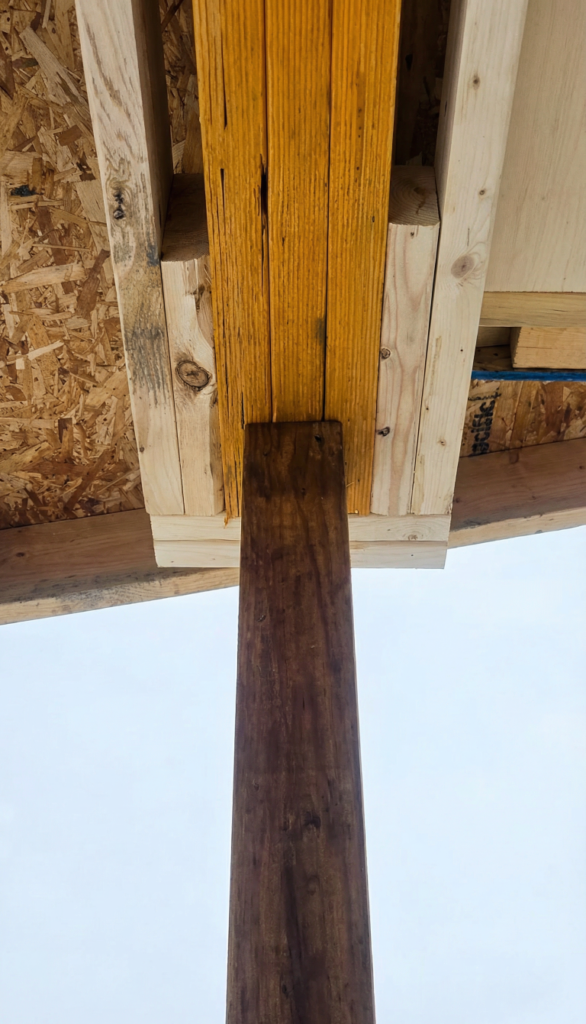
LVL beam bearing partially on a supporting post, reducing effective bearing area and altering the intended load path.
A common example involves engineered LVL beams that sit only partially on their supporting posts.
When only part of the beam bears on the post:
The effective bearing area is reduced.
Loads are transferred eccentrically rather than concentrically.
The post may experience bending forces instead of compression.
Over time, this can lead to compression of wood fibers, rotation of the supporting post, or deflection in the floor above. While these effects may not be immediately visible, inspection focuses on whether the connection clearly performs as intended.
Prescriptive Construction vs. Engineered Design
The Ontario Building Code provides prescriptive construction requirements that allow builders to proceed without engineering when specific dimensional and support conditions are met.
In general terms, supporting members are expected to be at least as wide as the members they support. When a beam is wider than the post below it, prescriptive compliance is not achieved.
LVL beams are engineered products and frequently exceed the width of standard dimensional lumber posts. In these situations, alternate bearing arrangements may be acceptable only when supported by engineered drawings that clearly show the permitted condition.
Without approved engineering documentation available on site, partial bearing of LVL beams is typically considered non-compliant during inspection.
Why Inspectors Flag These Conditions
Inspection is not based on whether framing feels solid or has not yet failed.
Inspectors verify:
Clear load paths.
Adequate bearing area.
Proper alignment of structural members.
Positive restraint where required.
If a connection does not clearly transfer load as designed, it is flagged — even if no visible damage is present at the time of inspection.
Why These Issues Are Harder to Correct Later
Framing deficiencies are often concealed once drywall, flooring, or ceilings are installed.
When bearing or alignment issues are identified late in construction, correction may require exposing finished areas to access the framing. Addressing these conditions during framing allows adjustments to be made while the structure is still visible and accessible.
Key Takeaway
Structural framing is not an area where “close enough” applies.
If bearing, alignment, or restraint is unclear, the work will likely fail inspection — even if it appears solid on site. Ensuring proper support and alignment during framing helps avoid inspection delays and supports long-term structural performance.
Disclaimer:
This article is for general educational purposes only. Building Code interpretation and enforcement may vary by municipality. Always confirm requirements with your local Authority Having Jurisdiction.