
Deck construction in Ontario often begins with a properly installed foundation, such as helical piles or concrete footings. However, the long-term performance of the deck depends just as much on how the wood posts are connected to that foundation.
A common field deficiency occurs when a deck post is not centered on the pile bracket or is inadequately fastened. Even when the pile itself is installed correctly, an improper post connection compromises load transfer, stability, and long-term performance.
When observed during inspection, this condition is typically considered non-compliant with the Ontario Building Code.
Field Example — Off-Centered Deck Post on Helical Pile
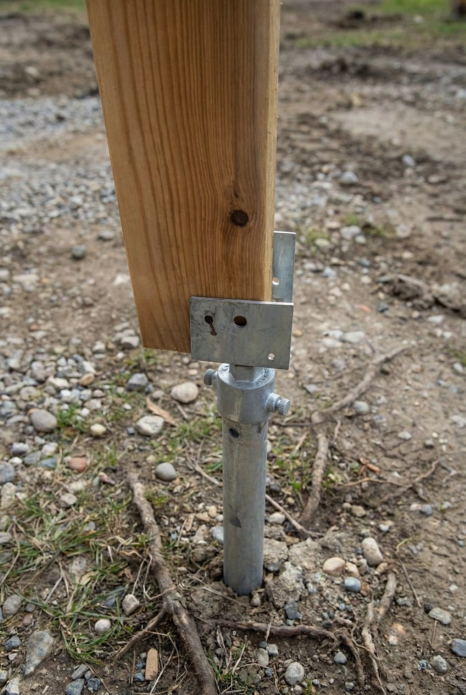
Field example showing deck post bearing near the edge of a helical pile bracket, creating eccentric loading.
In this example, the wood post bears near the edge of the pile bracket instead of being centered. Fastening is minimal and does not fully engage the bracket’s designed connection capacity.
Although the post is technically touching the support, this configuration does not meet the structural intent of the Code or the connector manufacturer’s requirements.
Why Centered Bearing Is Required
OBC 9.17.2.1.(1) — Columns Centrally Located on Footings
Plain-language requirement:
Columns must be centrally located on their footings.
This requirement ensures that:
- Loads transfer vertically through the center of the foundation element
- Bending forces are minimized
- Settlement and rotation risks are reduced
Deck posts are designed to carry primarily vertical loads. When a post is offset, the load path becomes eccentric, introducing stresses the system was not designed to resist.
Why Offset Posts Are a Problem
When a post is shifted toward the edge of a bracket:
- Loads become eccentric rather than centered
- Uneven pressure develops on the pile head and wood fibers
- The post may split, rotate, or settle unevenly over time
- Seasonal loading can gradually worsen alignment
Even small offsets can significantly reduce structural reliability.
For these reasons, this condition is typically flagged as a structural deficiency during inspection.
Fastening and Lateral Stability
OBC 9.17.2.2.(1) — Secure Attachment to Footings
Plain-language requirement:
Columns must be securely fastened to footings to reduce lateral differential movement.
Structural post bases and pile brackets are engineered to resist:
- Horizontal loads (wind, snow drift, live loads)
- Uplift forces
- Minor movement from frost or soil conditions
Common Fastening Deficiency
A frequent issue observed during inspection is installing only a single nail or light fastener in a bracket hole designed for:
- Structural bolts, or
- Heavy-duty structural screws
Light fasteners do not provide sufficient shear resistance or withdrawal capacity. Under wind or snow loading, an inadequately fastened post can shift or “kick out,” compromising deck stability.
Why This Deficiency Creates Risk
Improper post alignment and fastening can lead to:
- Eccentric loading on piles and posts
- Increased risk of rotation or settlement
- Reduced lateral resistance
- Long-term movement and misalignment
- Premature connection failure
- Costly retrofits after construction
Although the issue may appear minor during framing, it directly affects the deck’s structural load path.
Typical Correction Strategies (High Level)
Correction depends on site conditions and connector type, but may include:
- Re-centering the post on the bracket
- Installing proper structural bolts or approved fasteners
- Replacing undersized or incorrect brackets
- Adjusting post alignment before deck framing proceeds
- Verifying manufacturer fastening requirements
All structural connections must follow manufacturer instructions and approved drawings.
What Inspectors Commonly Verify
During inspection, verification typically includes:
- Post centered on footing or pile head
- Full bearing contact within the bracket
- Correct fastener type, size, and quantity
- Tight engagement of hardware
- Continuous load path from deck framing to foundation
Early correction prevents delays and expensive repairs later.
Key Takeaway
Deck posts must be centered and securely fastened to their supporting footings or piles.
“Close enough” alignment is not acceptable under the Ontario Building Code.
Even when foundations are installed correctly, improper post placement or fastening will result in an inspection failure.
Code References
- OBC 9.17.2.1.(1) — Columns Centrally Located on Footings
- OBC 9.17.2.2.(1) — Secure Attachment to Footings
Disclaimer
Disclaimer: This article is for general educational purposes only. Building Code interpretation and enforcement may vary by municipality. Always confirm requirements with your local Authority Having Jurisdiction.